Key Takeaways
- Load back to front by how often you need things, with rarely used items right at the back.
- Keep weight low and against the walls, and use furniture as structure to stack against.
- Everything goes in dry, up off the floor on pallets, with a small gap from the container walls.
- Use uniform boxes rather than bags, fill them fully, and label two sides not the top.
- No fuel, gas, paint, aerosols, food, plants or animals, and arrange your own contents insurance.
Does it really matter how you pack a storage container?
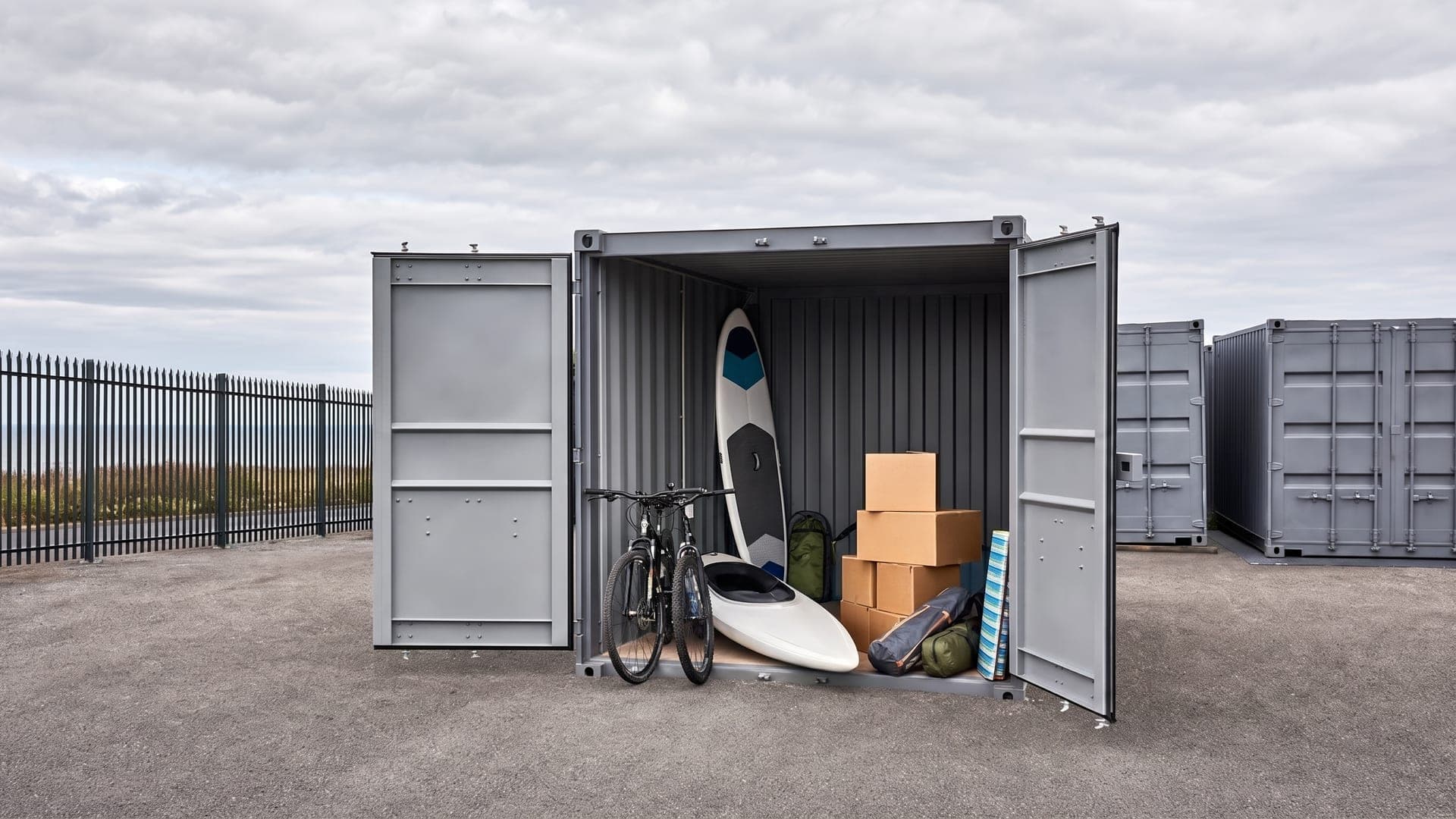
More than most people expect, and it costs money in two directions. Pack badly and you fill a 20ft container with what would have fitted in a 10ft, because half the volume is air trapped above wobbly stacks and awkward gaps. Pack badly in the other sense and you cannot reach the one box you actually need without unloading half of it onto the yard in the rain. The good news is that packing a container well is not complicated. It is mostly a matter of doing things in the right order and thinking about the shape of the space before you start carrying. A container is a rectangular steel box with one opening at the end, so everything follows from that: you are building from the back forwards, floor upwards, and you only get one face to work from. Spend twenty minutes planning and you will genuinely load faster than someone who starts by carrying the nearest thing in. If you have not decided on a size yet, our guide to storage container sizes covers what actually fits in a 10ft against a 20ft.
How do I pack so I can still get to things later?
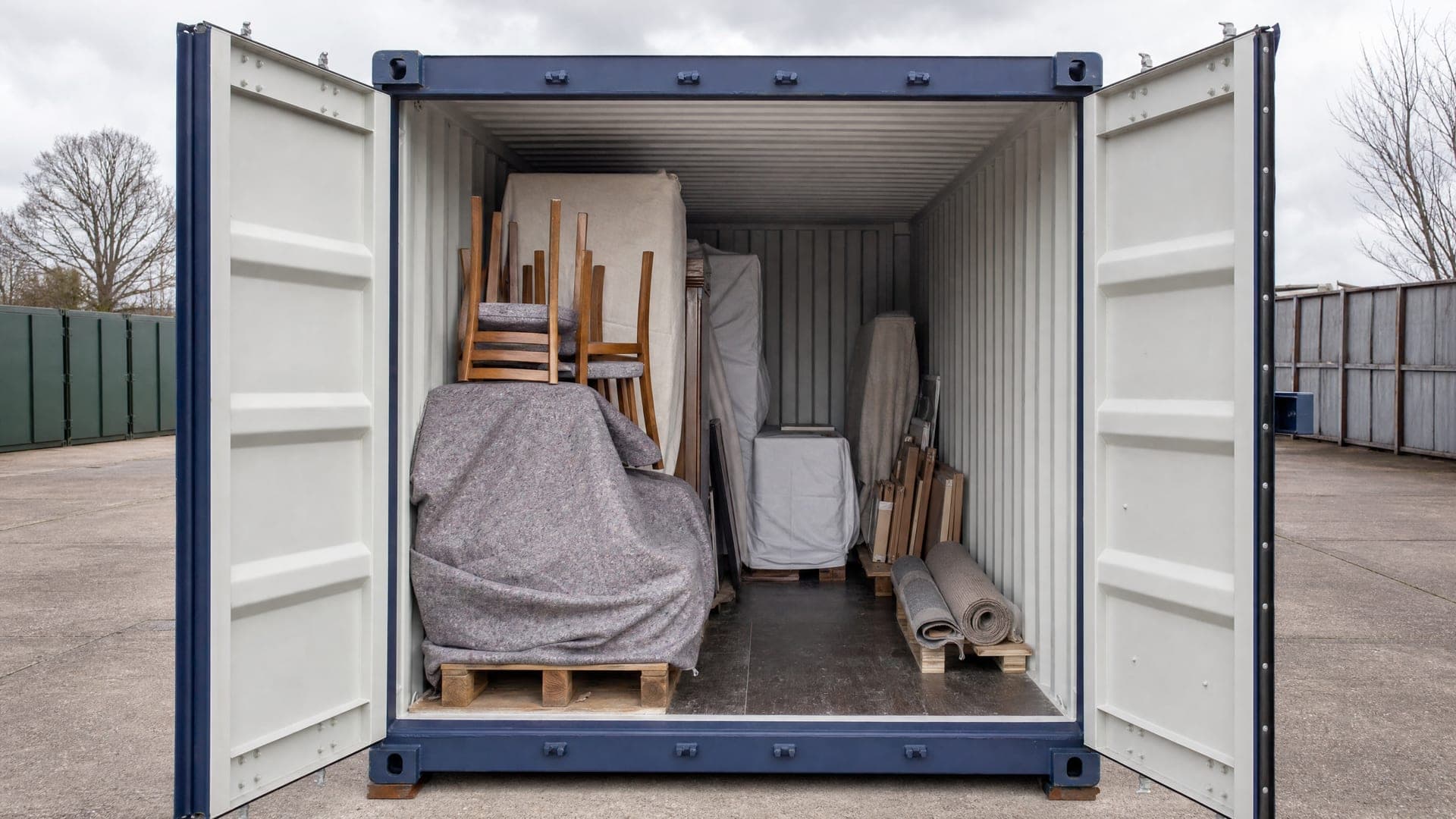
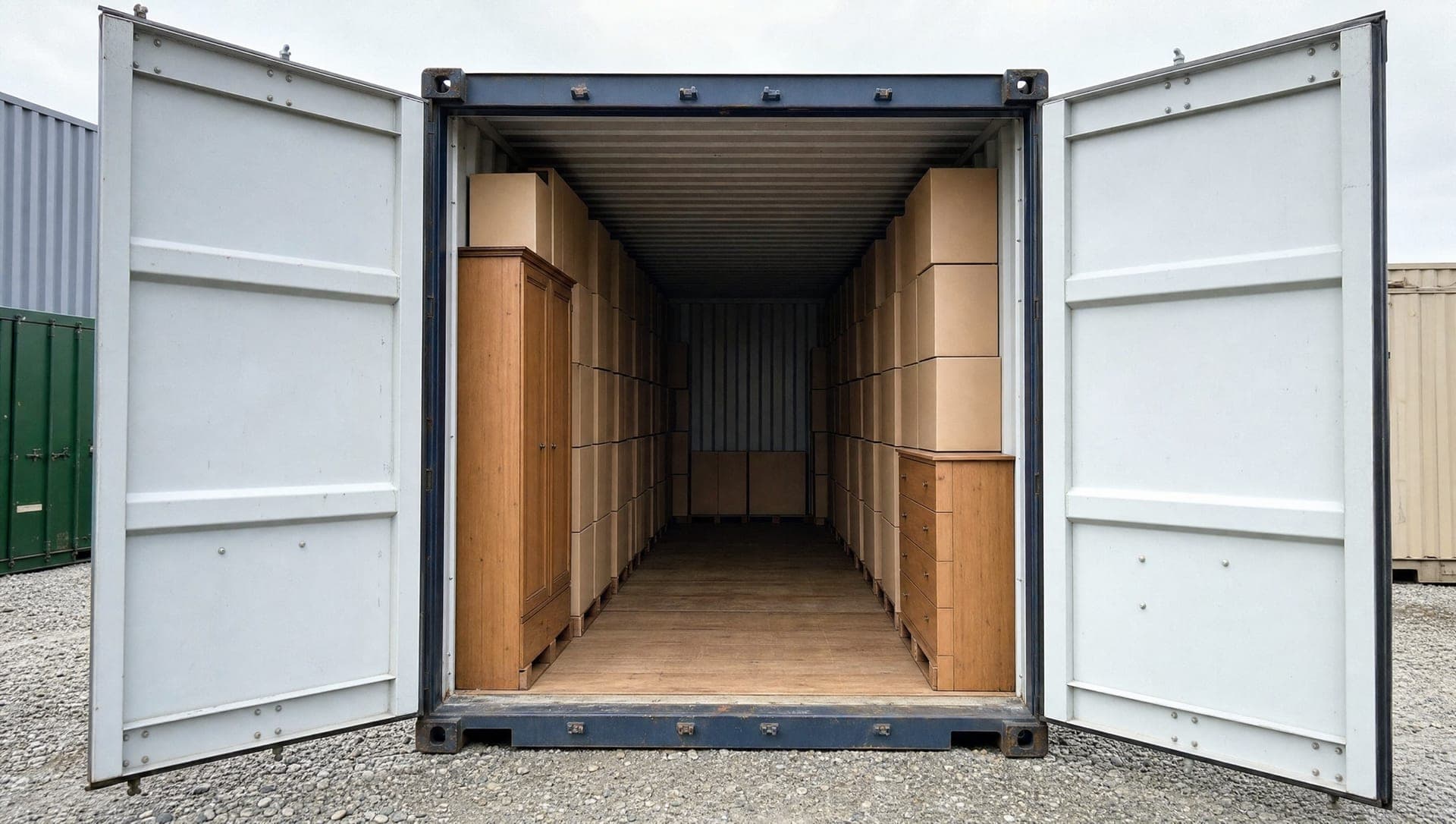
Split what you are storing into two piles before anything goes in: things you will want during the hire, and things you will not touch until the day you empty it. The second pile goes in first, right at the back, packed tight and floor to ceiling. The first pile goes nearest the doors. This sounds obvious and almost nobody does it, because things get loaded in the order they come off the van. The second habit worth building is an aisle. In a 20ft container, leaving a walkway of around two feet down one side costs you some volume but turns the container from a solid block into something you can actually walk into and work from. For anyone storing business stock or tools that move in and out weekly, that aisle pays for itself immediately. In a 10ft it is usually better to skip the aisle and instead keep a clear metre in front of the doors so you have somewhere to stand and shuffle boxes. Whichever you choose, label boxes on two sides rather than the top, because once they are stacked the top is the one face you cannot see.
What is the right way to load heavy items?
Weight goes low and it goes against the walls and the far end, never stacked high in the middle. Heavy boxes on the floor, lighter ones on top, and nothing heavy resting on anything that can crush, which rules out putting a toolbox on a box of crockery no matter how neatly it sits. Spread the load rather than concentrating it all at one end. Furniture and appliances are your building blocks, so put them in early and use them as structure. A wardrobe or a chest of drawers against the side wall gives you a flat vertical face to stack boxes against, and drawers themselves are storage, so fill them with linen or clothes rather than moving them empty. Sofas often go on their end to free up floor space, provided they are supported and not resting on a leg that will take the whole weight. Long items such as a ladder, curtain poles, timber or a mattress work best stood on edge along a side wall where they take up almost no floor and stop the stack from shifting.
How do I stop condensation damaging what I store?
This is the single most useful thing to get right, because a steel container is weatherproof but it is not climate controlled, and the temperature inside follows the weather outside. When warm damp air meets a cold steel roof you get condensation, and condensation is what actually damages things, not rain. Four habits deal with almost all of it. First, everything goes in dry. A washing machine that has not been drained, a tent packed away damp after a weekend away, or garden furniture put in wet will release that moisture into a sealed box and it has nowhere to go. Second, get things off the floor. A few pallets or lengths of batten cost almost nothing and give you an air gap underneath. Third, leave a small gap between your stack and the container walls so air can move rather than sitting still against cold steel. Fourth, cover with dust sheets or breathable covers rather than sealing things in plastic, because plastic traps moisture against the surface and is often worse than no cover at all. A few moisture absorber tubs in among the load are cheap and worth having. Our post on whether storage containers are damp and secure goes into this in more detail.
Boxes or bags, and what makes a good box?
Boxes, and ideally boxes that are all the same size. Uniform boxes stack square, hold their shape under weight and let you build a stable wall right up to the roof. Bin bags do none of those things: they slump, they slide off each other, they tear on the container floor, and anything soft inside comes out creased and smelling of plastic. The exception is bagging soft items to then load inside a rigid box or a drawer. Keep individual boxes to a weight one person can carry comfortably. Small boxes for books and tools, large boxes for bedding and cushions, and never the other way round, because a large box of books is a box nobody can lift and a box that will burst at the bottom. Fill every box to the top, using towels or bubble wrap to take up slack, since a half full box collapses as soon as you stack anything on it. Tape the base as well as the lid. Then label two sides with what is inside and roughly which room it came from, and keep a simple list on your phone. Six months in, that list is worth far more than you think it will be on loading day.
How should I store furniture, mattresses and appliances?
Dismantle whatever comes apart. Bed frames, table legs and flat-pack units take a fraction of the space in pieces, and putting all the fixings in a labelled bag taped to the underside of the item itself is the difference between a smooth reassembly and an afternoon of guessing. Wrap wooden and upholstered furniture in dust sheets or moving blankets rather than plastic, and pad corners and polished surfaces where things will lean against them. Mattresses are best stored flat if you have the room, or on edge if you do not, supported along their length so they cannot bow or fold over time. Fridges, freezers and washing machines should be fully drained and completely dry, then stored upright with the door propped slightly open, because a sealed appliance with any residual moisture will develop a smell that never really leaves. Mirrors, glass and pictures go on edge, wrapped and sandwiched between something soft and flat, never laid down where a box can be put on top of them by accident.
What should I not put in a storage container?
There are a few categories that do not belong in any storage container, ours included, and most of them are about safety rather than rules for their own sake. Nothing flammable or explosive: petrol, diesel, gas bottles, paint, solvents, aerosols and fireworks. Nothing perishable, which includes food and anything that will attract pests. No plants, no animals, and nothing living. Nothing illegal, and nothing you are not entitled to store. Beyond that, use your judgement about irreplaceable items. Passports, deeds, jewellery and anything with real sentimental value are better kept with you than in any storage unit anywhere. It is also worth knowing that we do not provide insurance for the contents of your container. Check whether your home contents or business policy extends to goods held in storage, and if it does not, arrange cover separately before you load. It takes ten minutes and it is the sort of thing people only think about after something has happened.
How do I plan the space before I start?
Walk round what you are storing with a tape measure and write down the big items with rough dimensions. Sofas, wardrobes, appliances, workbenches and anything long. Those are what dictate the size you need, because boxes will fill in around them but a wardrobe either fits or it does not. Then think in terms of a floor plan rather than a pile: which pieces go against which wall, where the aisle runs, and what you want nearest the doors. Get the containers ready before loading day too. Bring pallets or battens, dust sheets, a roll of tape, a marker pen and more boxes than you think you need. Running out of boxes halfway through is how bin bags end up in a container. If you are not sure whether you need a 10ft or a 20ft, tell us what is on your list and we will tell you honestly which one it fits in. Call 01670 332868, use our contact form, or read our storage FAQ. Our site is at 1 Dene Court, Bassington Lane, Cramlington, just off the A1 and A19, and we serve Cramlington, Newcastle upon Tyne, Blyth, Whitley Bay and across Northumberland and Tyne and Wear.
Why Choose EXO Storage?
- Drive-up access means you load straight from the vehicle instead of down a corridor.
- Two straightforward sizes, 10ft and 20ft, so you are not paying for space you cannot use.
- Weatherproof steel containers on a gated site with CCTV coverage and fob access.
- Honest advice on sizing before you book, not after you have signed.
- Cramlington site just off the A1 and A19, serving Newcastle, Blyth and Northumberland.