Key Takeaways
- Retained records that are rarely opened are the cheapest thing a business can move out of the office.
- A container suits bulk archive in sealed boxes, not fragile or climate-sensitive material.
- Number every box and keep a simple index, or you will not find anything two years later.
- Destroy what is past its retention period rather than paying to store it.
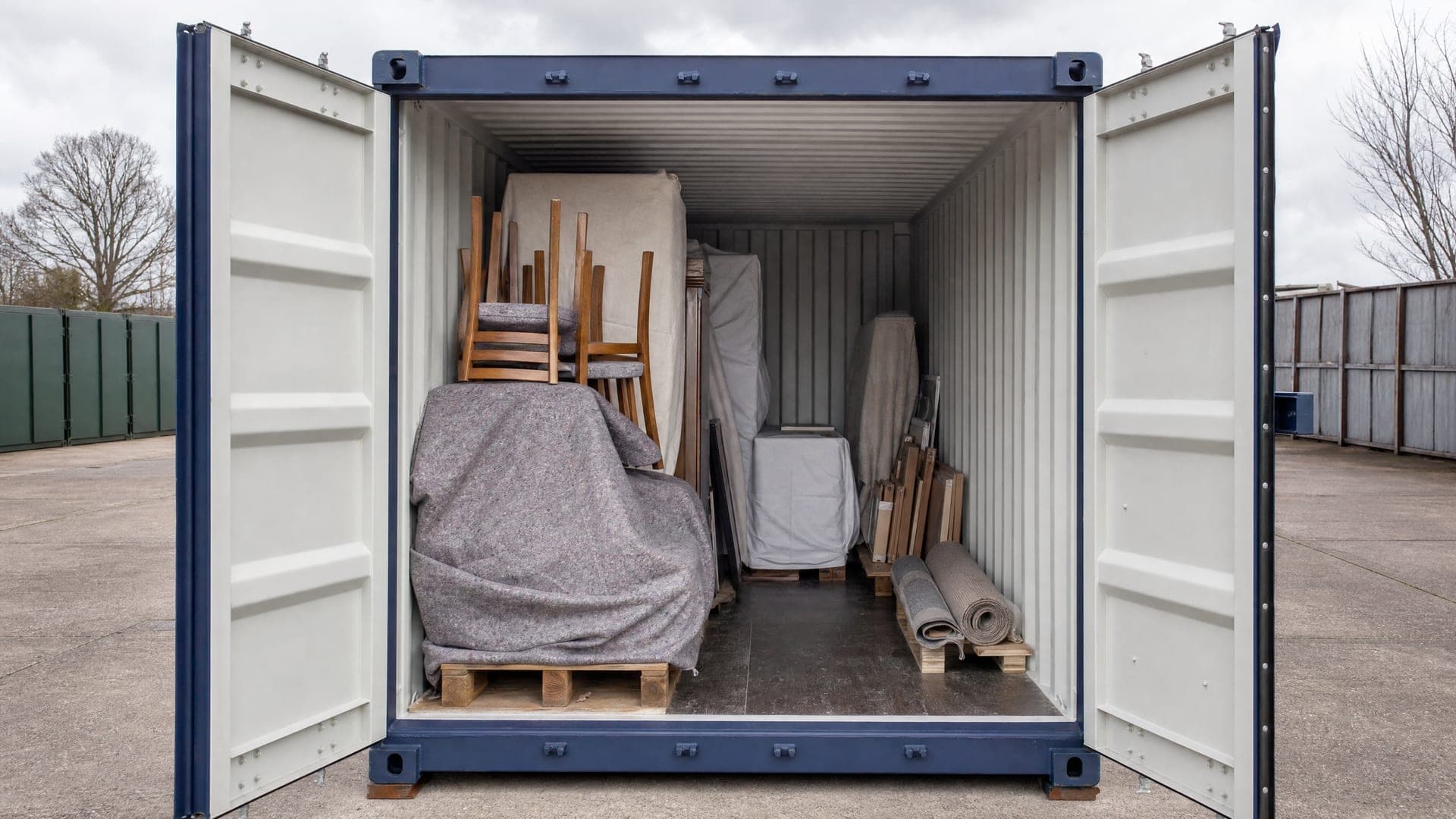
- A 10ft container holds a substantial small-business archive with room to move around it.
Why do businesses end up storing paper at all?
Because a lot of records have to be kept whether anyone wants them or not, and office space in and around Newcastle is too expensive to use as a filing cabinet. The usual pattern is a business that has been running long enough to have history. Finished client files, completed project paperwork, old payroll and accounts records, signed contracts, certificates and compliance paperwork. None of it is needed day to day. All of it has to be somewhere, and none of it should be taking up floor space that is being rented at office rates. The second pattern is a move or a refit. An office moving to a smaller or more open-plan space discovers that the new floor plan has nowhere to put twenty years of box files, and the archive has to go somewhere before the move, not after. Document storage in Newcastle usually starts with one of those two moments rather than with a plan.
Is a container the right place for business records?
For most of the archive, yes, and for a few things, no. A container works well for bulk records that have to be retained and retrieved occasionally rather than weekly. It is cheaper per square foot than office space, it is yours alone rather than shared, and you can get a pallet truck or a trolley straight up to the door, which is a bigger deal than it sounds when you are moving a hundred boxes rather than five. What a container is not is a climate-controlled archive. Anything genuinely fragile, such as very old bound records or photographic material, needs more than a steel box. For the ordinary run of business paperwork in standard archive boxes it is fine, provided it is packed properly, which mostly means off the floor and in sealed boxes rather than loose. Our guide to storage containers, damp and security covers the condensation question in detail, and it is worth reading before you box anything up. Paper is one of the materials where getting that right matters most.
What should go into storage, and what stays in the office?
Work through it in three piles rather than trying to decide box by box. The first pile is live: anything being worked on now, or likely to be needed within the month. That stays where you are. The second is retained: closed files that have to be kept for a retention period and will be opened rarely, if ever. That is what goes into storage, and it is usually the large majority. The third is disposal: material that is past its retention period and can be destroyed. Do that pile properly and securely rather than putting it in a container, because paying to store paper you are allowed to destroy is the most common waste in this whole exercise. Deciding how long you have to keep each kind of record is a question for your accountant or your own compliance policy rather than for us. What we can tell you is that the retained pile is nearly always bigger than people expect, and it is nearly always the cheapest thing in the business to store.
How do you keep an archive you can actually search?
This is where most self-stored archives go wrong. The boxes go in quickly during a clear-out, nobody writes anything on them, and two years later finding one file means opening forty boxes. A few habits fix it. Number every box on more than one face, so you can read it from the aisle. Keep a simple index, a spreadsheet is plenty, listing box number, contents, date range and destruction date. Group by year and by record type rather than by whichever desk the paperwork came from. Put the oldest material at the back and the most recent at the front, because recent is what gets asked for. And leave a walkway, because a container packed solid wall to wall is a container you cannot retrieve anything from. Our guide to packing a storage container covers loading order and keeping access, which matters more for an archive than for almost anything else you might store.
How much space does a business archive need?
Less than people think, because archive boxes stack well and stack high. We run 10ft and 20ft containers. A 10ft takes a substantial archive for a small or medium business with room to move around it, and a 20ft is the one for a larger archive, or for an archive plus the stock, equipment or furniture that usually comes with it. The guide to storage container sizes walks through what fits in each. Most businesses that start with records end up storing other things too. Tools, seasonal stock, spare equipment and old IT all tend to follow the box files out of the building once there is somewhere sensible to put them.
How do I get set up with archive storage near Newcastle?
We are at 1 Dene Court, Bassington Lane in Cramlington, just off the A1 and A19, which puts us within an easy run of Newcastle, Blyth, Whitley Bay, North Shields, Ashington and Morpeth. The site is gated with electronic fob access and covered by CCTV, and you hold the key to your own container. Minimum hire is one week and it rolls after that, with no penalty for extending or ending, which suits an archive that might need to sit for a year or might need to move again when the office does. To talk through what you are storing and what size would suit, have a look at our business storage page or get in touch. If you are storing stock rather than paperwork, our guide for online and eBay sellers covers that side of it.
Why Choose EXO Storage?
- Off the A1 and A19 in Cramlington, an easy run from Newcastle, the coast and Northumberland.
- Drive-up container access, so boxes go straight in from the vehicle with no lifts or corridors.
- Your own container and your own key, on a gated site with CCTV and fob access.
- One week minimum hire, rolling after that, so an archive is not a long contract.
- Two straightforward sizes, and honest advice on which one fits before you book.